


 RU
 UZ
Great medieval scholars who made outstanding contributions to mathematics, astronomy, geometry, philosophy, and medicine. Their discoveries and scientific works played an important role in the development of world science and continue to influence modern education and research today.
Legacy of the Islamic Golden Age
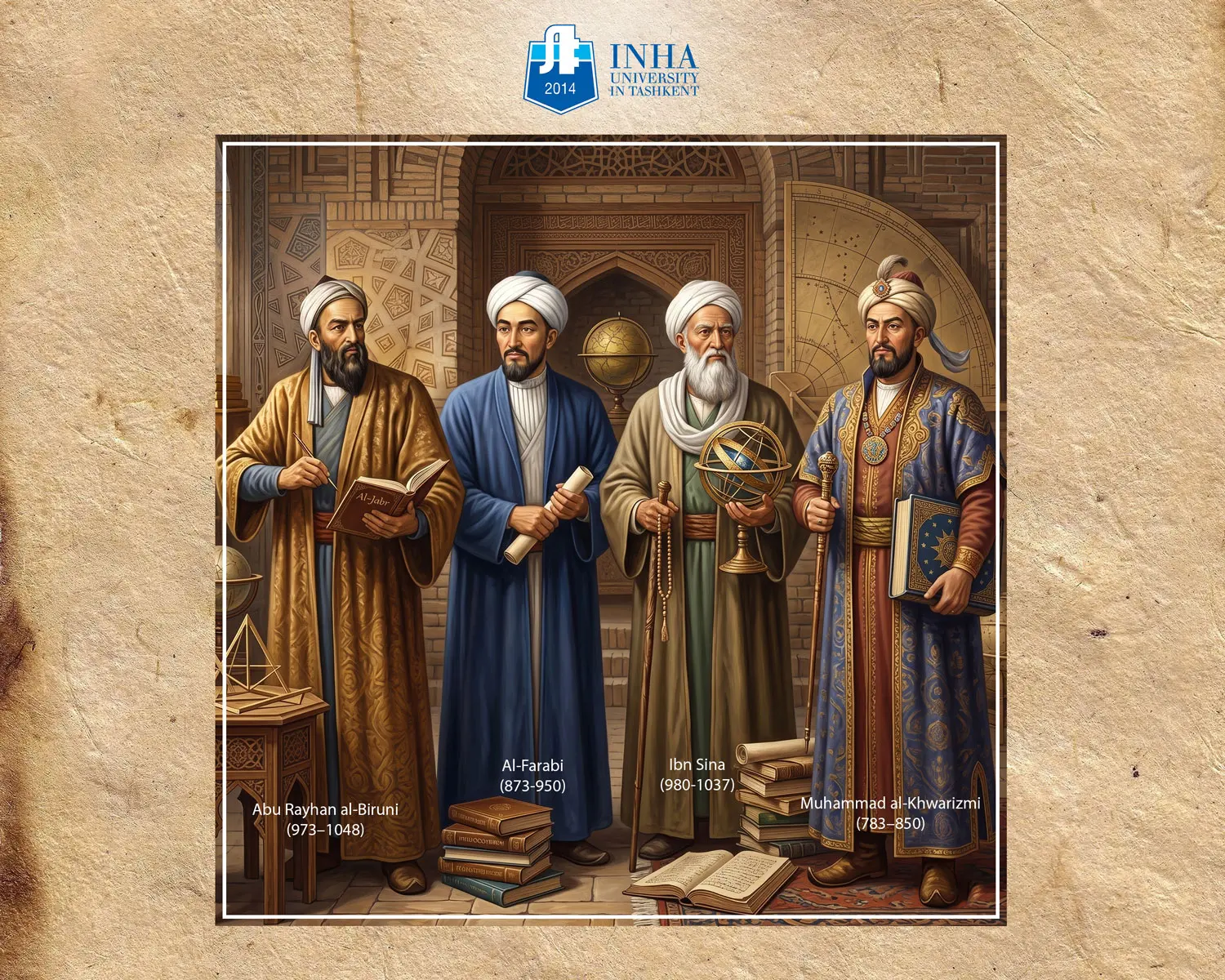
Abu Rayhan al-Biruni
(973 – 1048)
An outstanding polymath, astronomer, mathematician, geographer, and historian. He made significant contributions to geodesy and cartography, accurately calculating the Earth’s radius. He is often called the “founder of Indology” and the “father of comparative religion.”
Al-Farabi
(873 – 950)
A renowned philosopher and thinker, known as the “Second Teacher” (after Aristotle). He made enormous contributions to philosophy, logic, sociology, mathematics, and music theory. His works became a bridge between ancient philosophy and the Islamic world.
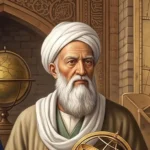
Ibn Sina
(980 – 1037)
One of the greatest physicians, philosophers, and scientists of the Islamic Golden Age. His major work, “The Canon of Medicine,” remained a standard medical textbook at universities in Europe and the Middle East for centuries.
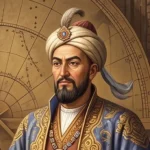
Muhammad al-Khwarizmi
(783 – 850)
A great mathematician, astronomer, and geographer, rightfully considered the “father of algebra.” The word “algebra” itself is derived from the title of his treatise “Kitab al-Jabr wa-l-Muqabala,” and his name gave the world the mathematical term “algorithm.”
